FCCDA - Fet Constant Current Draw Amplifier

A JFET Take on the CCDA Dual Triode Mic Circuit
Wednesday, November 12, 2025
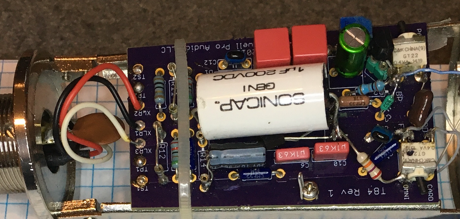
While working on the Weird Audio “Little Red Monster” tube mic, it occurred to me that the same idea of a common cathode input stage direct coupled to a cathode follower output stage with a transformer is easily done in solid state. Take a more or less standard KM-84 style circuit and tack on a source follower between the FET and the output capacitor, and voila! Only two additional parts, an FET, and a resistor.
There’s no change in voltage gain, but greater available current and a lower driving impedance make the transformer’s job easier. The circuit has greater control over the transformer’s frequency and transient response. To test the idea, I modified my KM-84 LDC test mic, described HERE.
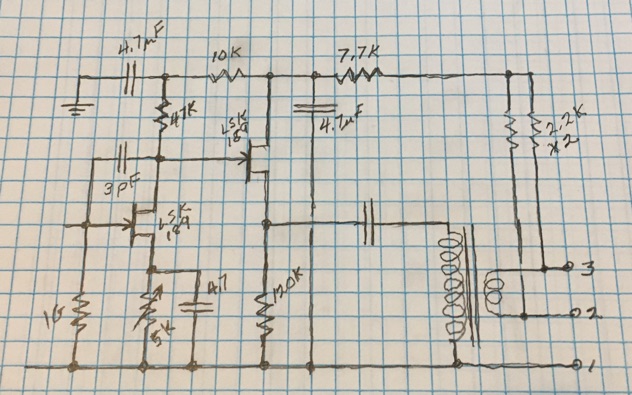
That was the first cut. It worked. Didn’t change the sound or capability of the mic, though. In the meantime, I had some refinements I wanted to make to the mic. It was too sensitive and overloaded, even with the pad engaged. There were other circuit refinements I had been planning to make, and I made them while the mic was apart. I gave the output stage more current, added some filtering to the phantom power circuit, and changed a couple more parts just because. It’s still a KM-84 style charge amplifier, but cleaner. So now the circuit looks like this:
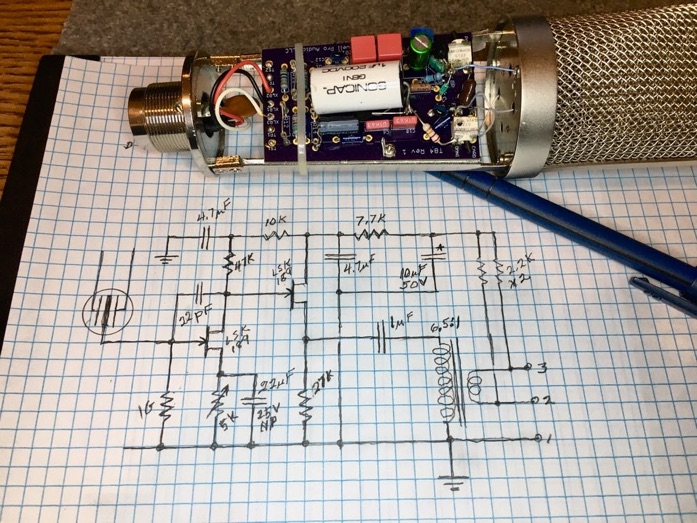
Is it worth the extra parts cost? To me, it is. It’s a cleaner, less compressed, more transparent KM-84 with an RK-47 large diameter capsule. It falls somewhere between the single FET ’84 and the op-amp mics, but with a bit of pure charge amp 2nd harmonic. Visible at the XLR plug in the photo, but not shown on the schematic are 0.001uF RF bypass caps. Combined with the transformer, RFI rejection is excellent, and since the capsule bias (again not shown on the digram) is taken directly from the 48V phantom supply like a normal KM-84, there is no internal oscillator noise. Ultrasonic hash is totally absent.
I’m tempted to build another one and buy a matched pair of capsules for use as a main pair. Time will tell. I have multiple matched pairs already, so we’ll see where this particular mic finds a place.


CAPSULE
INPUT
FROM 48V
CAPSULE BIAS & PATTERN SWITCH

